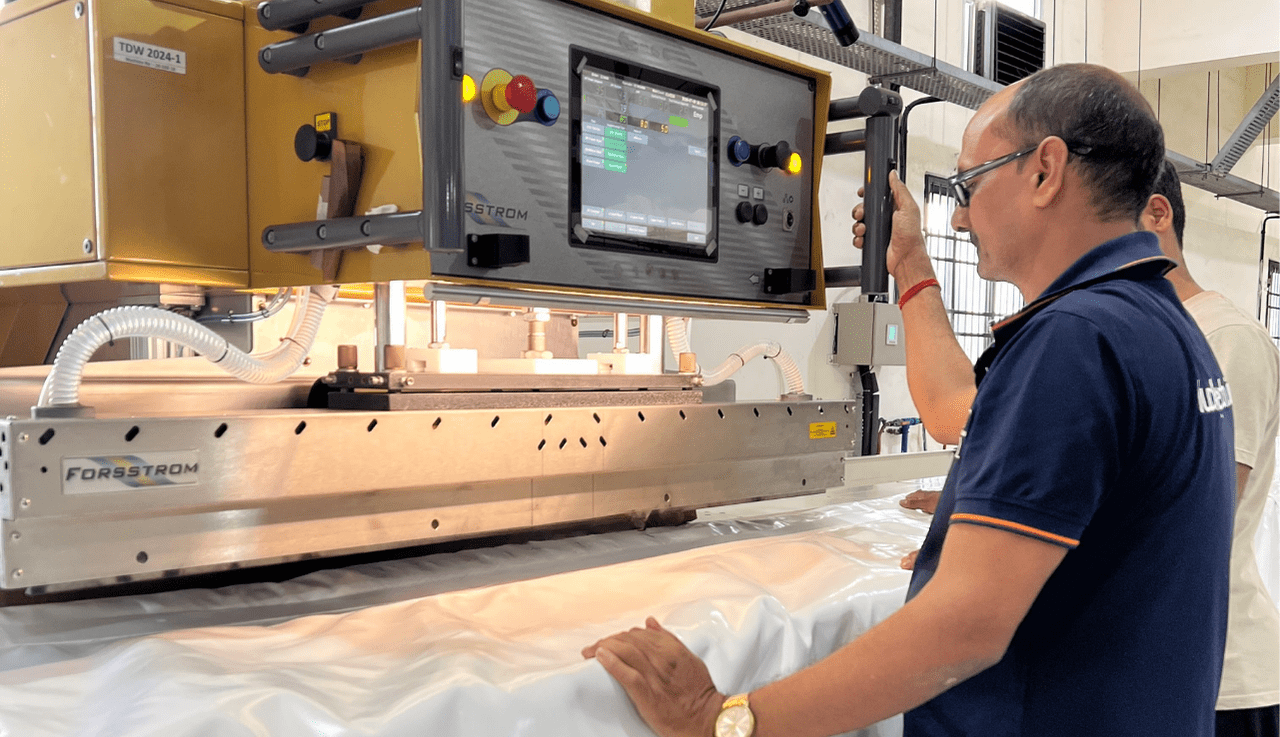
In the biogas industry, few topics generate as much unnecessary anxiety among plant operators as the subject of gas loss during thermal cycling. When ambient temperatures swing between a hot afternoon and a cool night, or between summer and winter, the membrane gas holder covering a digester or storage dome visibly moves — it swells, it contracts, it seems to “breathe.” Operators unfamiliar with the underlying physics sometimes interpret this movement, and the small associated gas volume changes that accompany it, as evidence of a leak or a manufacturing flaw. In reality, this behavior is a well-understood, well-documented, and fully expected characteristic of every properly engineered membrane gas storage system in the world. Understanding why requires a brief look at the physics of thermal expansion, the role of membrane design, and the regulatory frameworks — most notably Germany’s TRAS 120 — that govern how these systems should be built to keep any such loss within safe, negligible limits.
The Physics: Why Membranes Move With Temperature
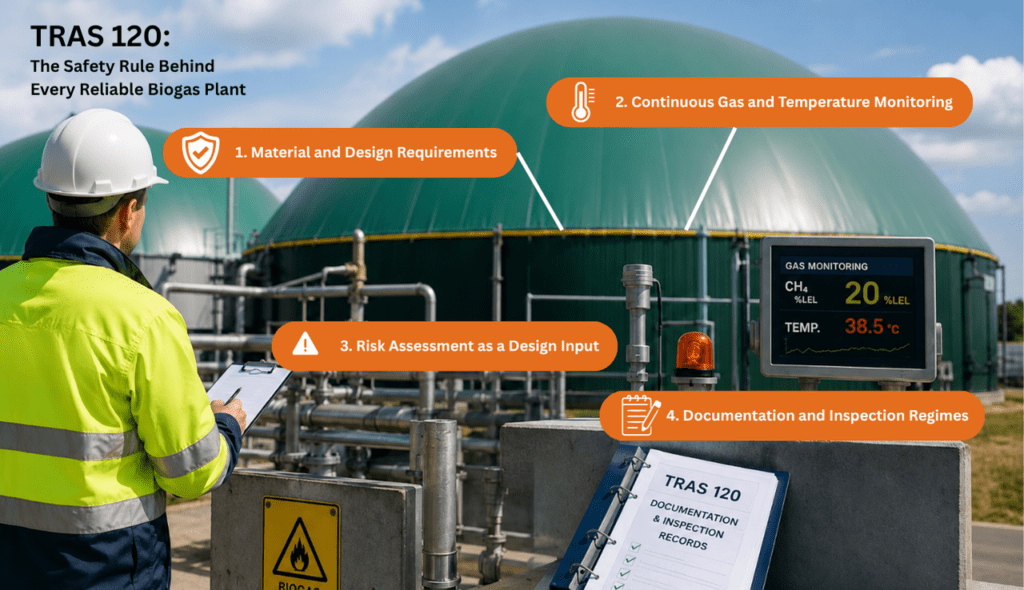
A biogas membrane gas holder is, functionally, a flexible envelope holding a fixed or semi-fixed volume of gas. Unlike a rigid steel tank, the membrane is designed to be elastic and responsive rather than dimensionally fixed — this flexibility is precisely what allows it to absorb pressure fluctuations safely, rather than transmitting stress into welds, anchor points, or the digester structure itself.
Gas, unlike a liquid or solid, obeys the ideal gas law: pressure, volume, and temperature are directly linked. When the sun heats the membrane surface during the day, the biogas trapped inside expands, causing the membrane to billow outward. As night falls and temperatures drop, the gas contracts, and the membrane visibly relaxes inward. This daily “breathing” cycle is not unique to any one manufacturer or product line — it occurs in every double-membrane gas holder, every biogas balloon, and every gasometer roof in operation, regardless of country or climate.
The important distinction is between volumetric movement (the membrane changing shape as gas expands or contracts) and gas permeation (actual methane molecules migrating through the membrane material itself and escaping to atmosphere). The former is a mechanical response to physics and involves no gas loss at all — the same gas simply occupies a different volume. The latter is a material property, and it is this permeation rate, under thermal stress, that engineering standards are designed to regulate and minimize.
Why a Small Amount of Permeation Is Expected — Not a Failure
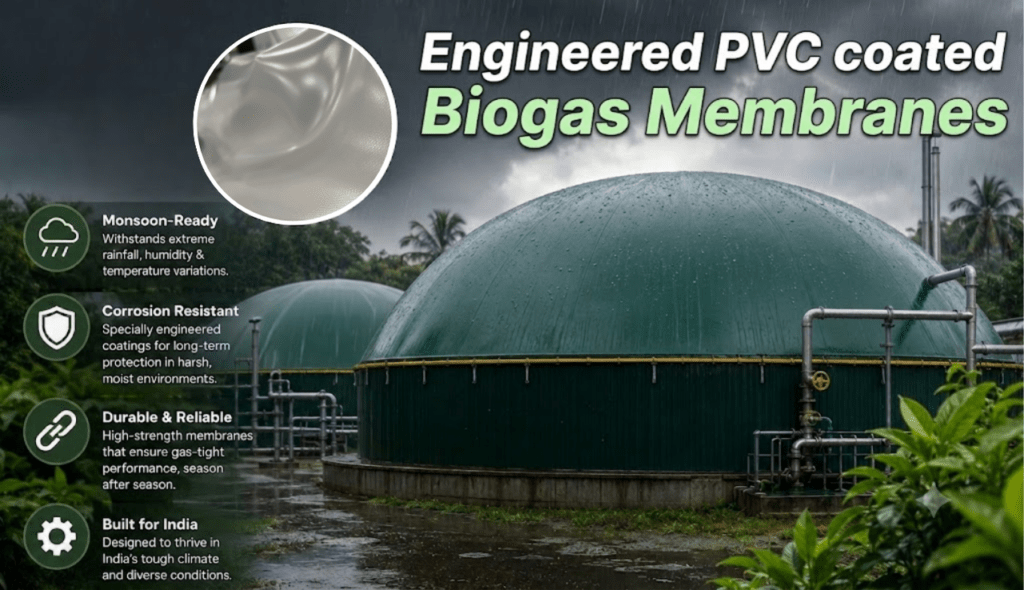
No polymer-coated fabric, PVC-coated or otherwise, is a perfect, absolute barrier to gas molecules at the molecular level. Methane, being a very small, non-polar molecule, has a measurable — though extremely low — permeation rate through even the best coated technical textiles. This is a known and quantifiable material property, typically expressed in units such as cm³/m²/day under standardized test pressures and temperatures.
European technical standards do not pretend this permeation rate can be reduced to absolute zero; instead, they define an acceptable upper threshold and require manufacturers to test and certify their membranes against it. This is a critical point for plant owners, EPC contractors, and engineers to understand: a membrane system passing European certification is not being tested for “zero loss,” it is being tested to confirm that gas loss remains within a defined, safe, and commercially negligible band — even under the added stress of repeated thermal expansion and contraction over the product’s service life.
Thermal cycling is specifically factored into these tests because repeated expansion and contraction can, over years of service, subtly affect coating integrity if the base fabric and coating formulation are not engineered for it. Premium membrane systems are therefore designed with coating chemistries, layer thicknesses, and fabric-coating adhesion specifically formulated to resist any meaningful increase in permeability as the membrane flexes through thousands of thermal cycles across its operational lifetime — often 15 to 20 years or more.
Germany’s TRAS 120: The Reference Framework
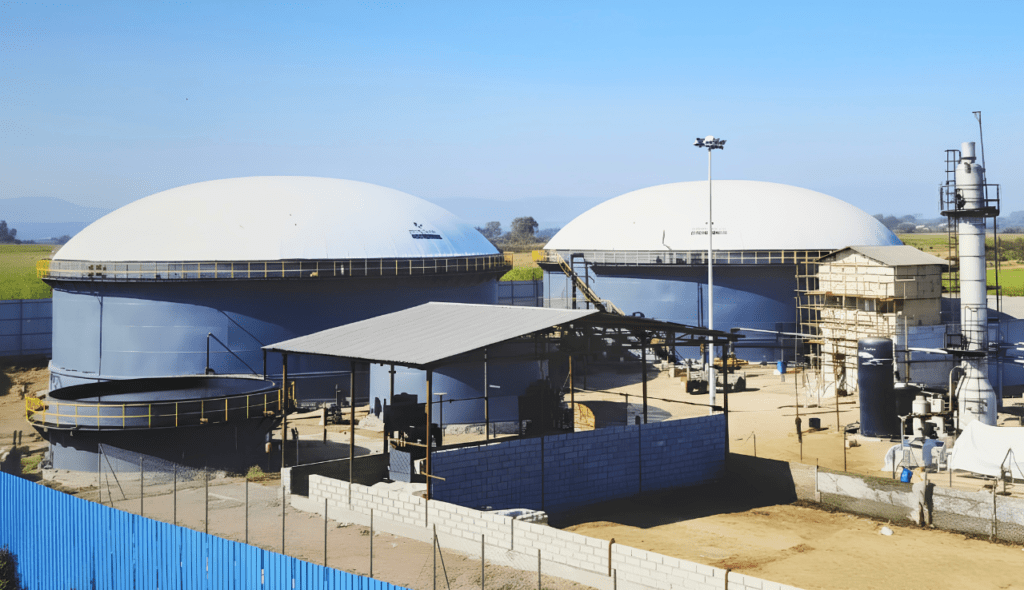
Among the global reference points for biogas plant safety and material performance, Germany’s TRAS 120 (Technische Regeln für Anlagensicherheit 120) occupies a particularly influential position. Published under the German Federal Ministry for the Environment, Nature Conservation, Nuclear Safety and Consumer Protection, <cite index=”2-1,4-1″>TRAS 120 sets out the technical safety requirements for biogas plants, and membranes certified against it are formulated to be flame retardant, temperature- and UV-resistant, electrically conductive with high adhesion values, and finished with low methane permeation properties.</cite>
Beyond material properties, <cite index=”2-1″>TRAS-120 defines broader technical requirements for biogas plants aimed at minimising risks such as fire and explosion, covering design requirements including materials, sealing systems, and tank and piping dimensions, alongside operational specifications for monitoring gases and temperatures, handling substrates, and managing pressure-relief systems.</cite> The guidelines also extend into ongoing plant operation: <cite index=”2-1″>TRAS-120 further specifies regular inspection, maintenance, and servicing requirements to ensure the plant continues operating safely over its lifetime.</cite>
Crucially, these guidelines exist precisely because European regulators, plant designers, and insurers have long since studied and accepted that some degree of gas movement and minimal permeation is inherent to membrane-based gas storage. Rather than treating this as a defect to be eliminated, the regulatory approach is to define engineering tolerances, testing protocols, and material specifications that keep any such loss firmly within safe, environmentally negligible, and commercially insignificant limits — regardless of daily or seasonal thermal cycling.
Manufacturers serving the European market design their gas-holder ranges specifically around this framework. <cite index=”4-1″>TRAS120-compliant biogas membranes are engineered to be chemical and biodigestion resistant, flame retardant, finished with a durable electrodissipative surface, and formulated for low gas permeability and a high solar reflection index, in order to meet the recommendations set out by independent technical assessors.</cite> The inclusion of high solar reflectivity is itself a direct engineering response to thermal cycling: by reflecting more solar radiation rather than absorbing it, the membrane surface temperature — and therefore the magnitude of daily gas expansion and contraction — is kept lower, further reducing stress on the coating and any associated marginal permeation.
What This Means for Plant Owners and EPCs
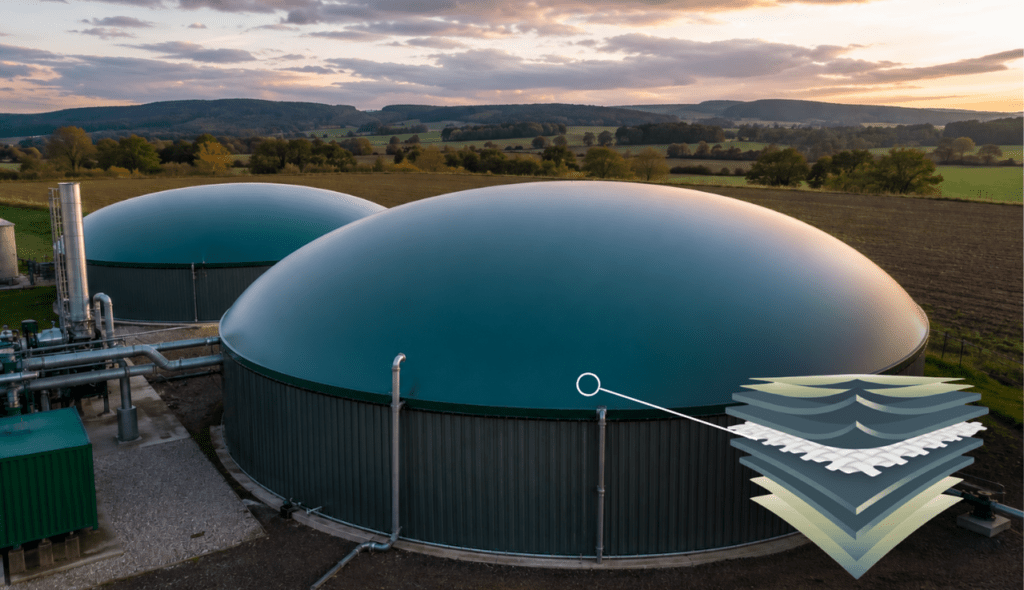
For biogas plant owners, EPC contractors, and dealers evaluating gas holder options, the presence of some thermal-cycling-related gas movement should not, by itself, be read as a warning sign. What matters is whether the membrane system supplying the plant has been engineered and independently tested against a recognized standard such as TRAS 120, with documented permeability figures, coating specifications, and reflectance data available from the manufacturer.
A credible supplier will be able to provide test certificates showing permeation rates well within accepted thresholds, along with details of coating formulation, UV and thermal resistance, and expected service life under real-world thermal cycling conditions. This transparency — not the absence of any visible membrane movement — is the true indicator of a well-engineered, standards-compliant biogas gas storage system.
In short, the gentle daily breathing of a membrane gas holder is not evidence of failure. It is the visible signature of a flexible engineering solution doing exactly what it was designed to do: absorbing thermal stress safely, while premium coated fabrics engineered to European norms like TRAS 120 ensure that any associated gas permeation remains a rounding error, not a risk.